

Strength Training After Stroke — What You and Your Family Should Know
If you or someone you love has survived a stroke and has been cleared by their doctor to begin exercise,…
06/05/2026
If you or someone you love has survived a stroke and has been cleared by their doctor to begin exercise, this resource is for you. A stroke is a life-changing event — for the person who experienced it and for the family supporting them. The road to recovery is rarely straightforward, and the question of what exercise is safe, helpful, and appropriate can feel overwhelming.
The evidence on this is clear and genuinely encouraging: structured strength training, done correctly and with appropriate guidance, is one of the most powerful tools available to support stroke recovery and long-term health. This resource explains why — and what it looks like in practice at Focus Health & Fitness.
A stroke occurs when blood supply to part of the brain is interrupted, either by a blockage or a bleed. The resulting brain injury can affect movement, strength, balance, coordination, speech, cognition, and mood — depending on which area of the brain was affected and the severity of the event. No two stroke survivors present identically, which is why individualised assessment and programming is so important.
Common physical effects that strength training can directly address include:
For many years, stroke rehabilitation focused primarily on relearning functional tasks — walking, dressing, daily activities. Strength training was often considered secondary or even potentially harmful. The research has shifted significantly. We now know that progressive resistance training is not only safe for stroke survivors who have been cleared for exercise — it is one of the most effective interventions available for improving long-term outcomes.
Here is what the evidence shows strength training can do for stroke survivors:
Strength training for stroke survivors is not the same as a standard gym program. It requires careful consideration of the individual’s affected side, movement compensations, fatigue levels, cardiovascular tolerance, and any cognitive or communication changes. Done well, it is progressive, purposeful, and deeply rewarding. Done poorly — or with a trainer who lacks relevant experience — it can be counterproductive or unsafe.
Key principles of effective strength training post-stroke include:
For stroke survivors, the environment in which they exercise matters enormously. A busy commercial gym — crowded, loud, with equipment that is difficult to navigate — is not the right setting. The risk of falls, the cognitive demands of a complex environment, and the emotional challenge of exercising publicly with visible physical limitations all present real barriers.
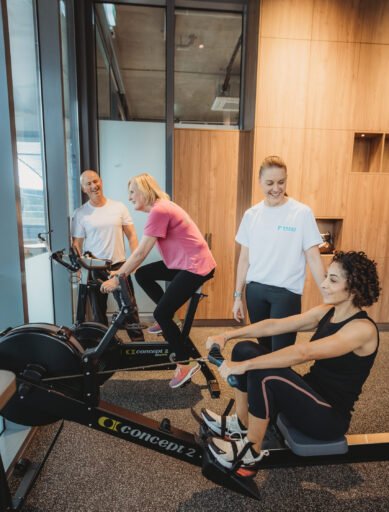
Our private studio in Norwest is a calm, quiet, one-on-one environment where sessions move at your pace, every session is supervised from start to finish, and there is no pressure, no comparison, and no distraction. For stroke survivors and their families, this kind of environment is not a luxury — it is a fundamental part of what makes exercise safe, sustainable, and genuinely enjoyable.
Learn more about personal training at our Bella Vista and Norwest studio.
Supporting a loved one through stroke recovery is demanding, often exhausting, and emotionally complex. One of the most valuable things a family member can do is encourage and facilitate regular, structured exercise — while understanding that progress after stroke is rarely linear. There will be good days and harder days. Fatigue will vary. Motivation will fluctuate.
What matters most is consistency over time, a supportive environment, and a coach who genuinely understands the unique demands of post-stroke exercise. If you are a family member accompanying your loved one to sessions, you are always welcome at Focus Health & Fitness. We work with the whole picture — not just the person in front of us.
Our Ryoga stretch and mobility classes can be a wonderful complement to strength training for stroke survivors, depending on the individual’s capacity and confidence. The focus on gentle, deliberate movement, breath awareness, and body connection supports the neurological reconnection that is central to stroke recovery. Ryoga also addresses the spasticity and stiffness that many stroke survivors experience, and provides a calming, restorative session that supports both physical and emotional recovery.
We assess each individual’s suitability for Ryoga on a case-by-case basis and will always work with you and your medical team to ensure the approach is appropriate.
Find out more about Ryoga — yoga and stretch classes in Baulkham Hills.
At Focus Health & Fitness, we work collaboratively with the medical and allied health professionals involved in a stroke survivor’s care. If your loved one has been seen by a neurologist, physiotherapist, or rehabilitation specialist, we welcome any relevant information about their condition, restrictions, and goals. The more we understand, the better we can serve them.
Before beginning, we ask that all stroke survivors have written clearance from their GP or specialist to participate in supervised exercise. This protects everyone and ensures we are working within the boundaries that are right for each individual.
One of the most important things to understand about stroke recovery is that neuroplasticity — the brain’s capacity to adapt and rewire — continues for years after a stroke, not just in the first months of formal rehabilitation. This means that the work done in structured exercise sessions long after hospital discharge can continue to produce meaningful neurological and physical improvements. It is never too late to benefit from a well-designed exercise program.
We are here for the long term. Many of our clients have been training with us for a decade or more. That kind of sustained, consistent relationship is exactly what stroke recovery — and long-term health — is built on.
If you would like to talk about how we can support your loved one’s recovery, please reach out. We will take the time to understand your situation and be honest with you about how we can help.
Get in touch with our team here — we’d love to talk.
Health and happiness,
Ryan Fraser
Disclaimer: This resource is for general educational purposes only and does not constitute medical advice. Exercise programming for stroke survivors must be individually assessed and supervised by qualified professionals, and undertaken only with written clearance from the treating medical team. Always consult your GP, neurologist, or rehabilitation specialist before beginning or modifying an exercise program post-stroke.

baulkham hills, Bella vista, norwest, personal trainer, personal training, stroke
If you work at Norwest Business Park, you already know the paradox. You’re surrounded by one of Sydney’s most beautifully…
13/08/2026

