

What Is Functional Fitness — And Why It Matters More Than You Think (Hills District Guide)
If you live in Norwest, Bella Vista, Castle Hill or the wider Hills District and you’ve heard the term functional…
27/05/2026
If you live in Norwest, Bella Vista, Castle Hill or the wider Hills District and you’ve heard the term functional fitness but aren’t entirely sure what it means — or whether it’s relevant to you — this post is for you. Functional fitness is one of the most important and most misunderstood concepts in health and exercise, and understanding it changes the way you think about what training is actually for.
Functional fitness refers to exercise that trains the body for the movements and demands of real life — not just the movements performed in a gym. A functional approach to training asks: what does this person actually need to be able to do? Getting up from a chair. Carrying shopping. Picking something up from the floor. Climbing stairs without pain. Playing with grandchildren. Reaching overhead. Carrying luggage through an airport. Walking long distances without fatigue. These are the things that determine quality of life — and they are exactly what functional fitness training is designed to support and protect.
This is in contrast to training approaches that focus on isolated muscle development, aesthetic outcomes, or performance metrics that don’t translate meaningfully to daily life. A person can have large, visually impressive muscles and still struggle to get off the floor without assistance — because the training they did never required their body to function as an integrated system.
Functional fitness is built around a small number of movement patterns that the human body performs in daily life and that, when trained well, transfer directly to improved physical capacity across almost every situation:
A well-designed functional fitness program trains all of these patterns progressively and with appropriate technique — building the strength, stability, and mobility that make everyday physical life easier, safer, and more enjoyable.
For younger adults, poor functional fitness is an inconvenience. For adults over 40, 50, and 60, it becomes a genuine quality of life issue — and eventually a safety issue. The ability to get up from the floor independently is a significant predictor of long-term health outcomes in older adults. Balance and lower limb strength are the primary determinants of fall risk — and falls are one of the leading causes of injury, hospitalisation, and loss of independence in older Australians.
Functional fitness training directly addresses these outcomes. Building the strength, balance, coordination, and mobility needed for real-world physical demands is not just about feeling better in the gym — it is about maintaining independence, capability, and quality of life for decades.
This is the philosophy at the core of everything we do at Focus Health & Fitness. We are not training people to look good in a mirror. We are training people to live well — for as long as possible.
Aesthetic training focuses primarily on how the body looks — developing specific muscle groups for visual effect, often using isolated exercises on machines that work one muscle in one plane of motion. This approach has its place, but it produces a body that looks capable rather than one that is capable.
Functional training focuses on what the body can do — developing strength, stability, mobility, and coordination across the full range of movements that life demands. The visual outcomes of functional training — a leaner, stronger, more upright, more capable-looking body — are a byproduct of training for function, not the goal.
For most adults over 35 — the people we work with at Focus Health & Fitness — functional outcomes are almost always more relevant and more motivating than aesthetic ones once they understand the distinction. Feeling strong getting off the floor. Carrying all the shopping in one trip. Walking up stairs without losing breath. These are the things that actually improve daily life.
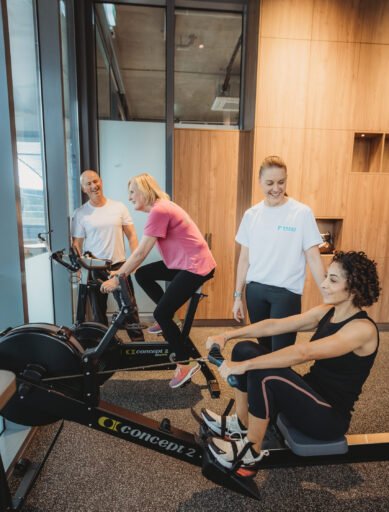
At our private studio in Norwest, a functional training session for an adult client typically includes:
This is very different from a generic gym program. It requires an experienced coach who understands both the principles of functional movement and the specific demands and limitations of the individual in front of them.
Functional fitness requires adequate mobility — the ability to move joints through the ranges of motion that functional movements demand. For many adults, restricted hip mobility, thoracic stiffness, or poor ankle mobility limits how well they can perform fundamental movement patterns and how safely they can progress their training.
Our Ryoga stretch and mobility classes directly address the mobility foundations that make functional training more effective. Clients who combine strength training with regular Ryoga sessions consistently move better, progress faster, and experience less pain and stiffness both in training and in daily life. The two practices are genuinely synergistic — each making the other more effective.
Find out more about Ryoga — yoga and stretch classes in Baulkham Hills.
The concept of longevity performance — training not just for how you look or perform now, but for how well you function at 70, 80, and beyond — is central to the approach we take at Focus Health & Fitness. The research on healthy ageing is clear: the adults who maintain physical independence, cognitive sharpness, and quality of life into old age are overwhelmingly those who maintained consistent, purposeful physical activity throughout their adult life.
Functional fitness training is not just preparation for the next gym session. It is preparation for the next decade — and the one after that. Every session that builds strength in your hinge pattern is an investment in your ability to pick things up off the floor at 75. Every session that trains your single-leg stability is an investment in your ability to walk confidently without fear of falling at 80. This long-term perspective is what separates a meaningful training program from one that simply fills time.
We work with adults from Norwest, Bella Vista, Castle Hill, Glenhaven, Kellyville, Rouse Hill and surrounding suburbs who want to train with purpose — not just to look different, but to function better, feel stronger, and maintain the physical capacity that makes a full life possible. If this approach resonates with you, we’d love to talk.
Book a free consultation with our team here.
Health and happiness,
Ryan Fraser

baulkham hills, Bella vista, castle hill, hills district, kellyville, norwest, personal trainer, personal training
If you work at Norwest Business Park, you already know the paradox. You’re surrounded by one of Sydney’s most beautifully…
13/08/2026

