How to Exercise with Multiple Sclerosis — A Guide for Adults and Families in the Hills District
If you have been diagnosed with multiple sclerosis and you live in Norwest, Bella Vista, Castle Hill or the wider…
09/06/2026
If you have been diagnosed with multiple sclerosis and you live in Norwest, Bella Vista, Castle Hill or the wider Hills District — or if someone you love is living with MS — this post is written for you. Multiple sclerosis is a complex, unpredictable neurological condition that affects movement, sensation, energy, and many other aspects of daily life. For many years, people with MS were advised to avoid strenuous exercise for fear of worsening symptoms. That advice is now outdated. The evidence shows clearly that appropriate, well-structured exercise is safe, beneficial, and for many people with MS, transformative — improving physical function, reducing fatigue, supporting mental health, and enhancing quality of life in ways that medication alone cannot achieve.
Multiple sclerosis is an autoimmune condition in which the immune system attacks myelin — the protective sheath surrounding nerve fibres in the brain and spinal cord. This demyelination disrupts or blocks the nerve signals that control movement, sensation, vision, bladder function, and cognition. The resulting symptoms vary enormously between individuals depending on which areas of the nervous system are affected:
MS follows different patterns in different people — relapsing-remitting MS, secondary progressive MS, and primary progressive MS each present differently and have different implications for exercise programming.
The shift in understanding about exercise and MS has been significant and rapid. What the research now shows:
Heat sensitivity — known as Uhthoff’s phenomenon — is one of the most important practical considerations in exercise for MS. Many people with MS experience a temporary worsening of symptoms when body temperature rises — blurred vision, increased weakness, greater fatigue, and coordination difficulties. This is not a sign of disease progression and resolves as body temperature returns to normal, but it requires careful management during exercise:
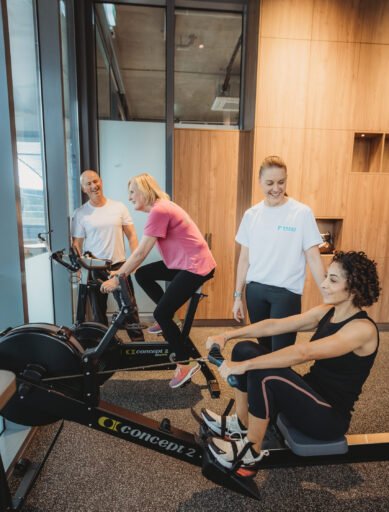
Our private studio in Norwest is air-conditioned and temperature-controlled — an important practical advantage for clients with MS who need a cool, controlled exercise environment.
Resistance training is foundational for people with MS. Building and maintaining muscle strength counteracts the weakness and spasticity that MS produces, improves functional capacity for daily activities, and reduces fall risk. Progressive resistance training — carefully designed around the individual’s affected muscle groups, fatigue patterns, and functional goals — produces consistent improvements in strength and daily function for people with MS across a range of disability levels.
Aerobic exercise improves cardiovascular fitness, reduces fatigue, and supports mood. Low to moderate intensity aerobic work — walking, cycling, swimming, or seated aerobic exercise depending on mobility level — is well tolerated by most people with MS when intensity is managed to avoid excessive heat production.
Balance and coordination training directly addresses the postural instability and fall risk that MS produces. Progressive balance challenges, tailored to the individual’s current capacity and adjusted for fatigue levels, produce meaningful improvements in stability and confidence.
Flexibility and spasticity management — regular stretching addresses the muscle tightness and spasticity that affect many people with MS, reducing discomfort and improving the range of motion available for functional movement and exercise.
Fatigue management within sessions — MS fatigue is distinct from ordinary exercise fatigue and must be actively managed. Session structure, rest intervals, and the timing of exercise relative to medication and daily energy patterns all require careful consideration. The goal is to provide a meaningful training stimulus without producing the post-exertional fatigue that can follow a session that exceeds the individual’s current capacity.
During an MS relapse — a period of new or worsening neurological symptoms — exercise should be modified significantly or temporarily paused, depending on the severity of the relapse. The priority during a relapse is recovery, and introducing significant physical stress during an active relapse is not appropriate. Gentle range of motion work and light activity may be maintained where tolerated, but the decision to exercise during a relapse should always be made in consultation with the treating neurologist.
Following relapse recovery, exercise is resumed gradually — starting at a lower intensity than before the relapse and building back progressively. Relapses do not permanently erase the fitness and strength built through consistent training; most of it returns relatively quickly with systematic rebuilding.
Our Ryoga stretch and mobility classes offer several specific benefits for people with MS. The gentle, deliberate movement and progressive stretching directly addresses spasticity and muscle tightness — two of the most physically uncomfortable aspects of MS. The breath work and nervous system regulation that Ryoga provides supports the stress and anxiety management that is important for MS wellbeing. The cool, quiet environment of our studio and the slow, mindful pace of Ryoga makes it particularly accessible for people with MS who find more intense exercise environments overstimulating or physically challenging.
Many clients with MS find that Ryoga is the session they look forward to most — providing physical relief, mental calm, and a genuine sense of body connection that is deeply valuable when MS can make the body feel unreliable and unfamiliar.
Learn more about Ryoga — yoga and stretch classes in Baulkham Hills.
Living with MS is a lifelong journey — and so is supporting someone who has it. Exercise is one of the areas where family encouragement and practical support makes a genuine difference to adherence and outcomes. Understanding the specific considerations of MS exercise — heat sensitivity, fatigue management, relapse adjustment — helps family members support their loved one’s program intelligently rather than anxiously.
Family members are always welcome at Focus Health & Fitness, and we work with the whole family picture to provide exercise support that is genuinely integrated into daily life.
Exercise for MS works best as part of a coordinated approach with your neurologist, MS nurse, physiotherapist, and GP. We welcome communication with the full care team and are happy to provide exercise program documentation to treating clinicians. Before beginning a new exercise program, always discuss it with your neurologist — particularly if your MS is at a more advanced stage or if you are currently in or recently recovered from a relapse.
We work with adults managing MS and their families from Norwest, Bella Vista, Castle Hill, Glenhaven, Kellyville, Rouse Hill and surrounding suburbs. Our private, air-conditioned studio, experienced coaching team, and individually designed programs make us the right environment for people with MS who need a thoughtful, knowledgeable, and genuinely supportive approach to exercise.
If you or a loved one has MS and you are looking for expert exercise support, we would be honoured to help.
Book a free consultation with our team here.
Health and happiness,
Ryan Fraser
Disclaimer: This post is for general educational purposes only and does not constitute medical advice. Exercise programming for multiple sclerosis must be individually assessed and supervised by qualified professionals, and undertaken in close consultation with the treating neurologist and medical team. Always consult your neurologist or GP before beginning or modifying an exercise program if you have been diagnosed with MS. Exercise should be modified or paused during active relapses in accordance with medical advice.

baulkham hills, Bella vista, castle hill, hills district, kellyville, multiple sclerosis, norwest, personal trainer, personal training

Every week, GPs across the Hills District tell patients the same thing: “You need to exercise more.” Lose some weight….
23/10/2026