

How to Exercise with Multiple Sclerosis — A Guide for Adults and Families in the Hills District
If you or someone you love has been diagnosed with multiple sclerosis and you live in Norwest, Bella Vista, Castle…
02/06/2026
If you or someone you love has been diagnosed with multiple sclerosis and you live in Norwest, Bella Vista, Castle Hill or the wider Hills District, this post is written for you. Multiple sclerosis is a complex, unpredictable neurological condition that affects the central nervous system — and for many years, people with MS were advised to avoid strenuous exercise out of concern that it would worsen symptoms or accelerate progression. The evidence has comprehensively reversed this position. We now know that appropriate, well-designed exercise is not only safe for people with MS — it is one of the most effective strategies available for managing symptoms, maintaining function, supporting mental health, and improving quality of life.
Multiple sclerosis is an autoimmune condition in which the immune system attacks the myelin sheath — the protective covering of nerve fibres in the brain and spinal cord. This disrupts the transmission of nerve signals, producing a wide range of symptoms that vary significantly between individuals and over time:
The pattern of MS varies — relapsing-remitting MS involves periods of symptom flare (relapses) followed by partial or complete recovery, while progressive forms involve gradual worsening over time. Exercise programming must account for which type of MS is present and where the individual currently sits in their disease course.
The research on exercise and MS has been remarkably consistent and encouraging:
Heat sensitivity — known as Uhthoff’s phenomenon — is one of the most important exercise considerations for people with MS. Many people with MS experience temporary worsening of symptoms when their core body temperature rises, making exercise in warm environments particularly challenging. This does not mean exercise should be avoided — it means heat management is a critical part of exercise planning:
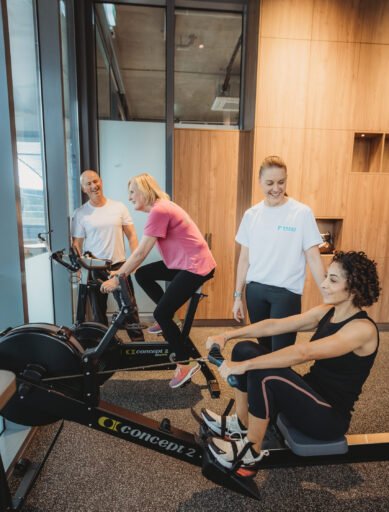
Our private studio in Norwest is air-conditioned and provides the cool, controlled environment that makes exercise manageable and comfortable for people with heat-sensitive MS — a significant practical advantage over outdoor or non-climate-controlled settings.
Resistance training — essential for function and fatigue management. Progressive strength training addresses the muscle weakness and deconditioning that accumulate with MS and its associated activity restrictions. Building strength — particularly in the lower limbs — directly improves walking ability, reduces fall risk, and provides the functional reserve needed for daily activities. Strength training also produces some of the most consistent reductions in MS-related fatigue of any exercise modality.
Aerobic exercise — carefully managed intensity. Aerobic exercise improves cardiovascular fitness, reduces fatigue, supports mood, and provides cognitive benefits. The key for people with MS is managing intensity to avoid excessive core temperature elevation and symptom provocation. Moderate-intensity aerobic exercise, performed in a cool environment with careful symptom monitoring, is safe and beneficial for most people with MS.
Balance and coordination training. Balance impairment is common in MS and a primary driver of fall risk. Targeted balance work — progressed carefully from stable to unstable surfaces, from static to dynamic challenges — significantly improves postural stability and reduces falls. This is a non-negotiable component of any comprehensive MS exercise program.
Flexibility and spasticity management. Spasticity — the muscle stiffness and involuntary spasms characteristic of MS — responds well to regular stretching and mobility work. Maintaining range of motion in the affected limbs reduces discomfort, improves movement quality, and supports the ability to perform both exercise and daily activities.
Aquatic exercise. Water-based exercise is particularly well-suited to people with MS — the cool water environment manages heat sensitivity, buoyancy reduces the impact of muscle weakness on movement quality, and the sensory environment of water is often comfortable for people with MS-related sensory disturbances. While we do not provide aquatic sessions at our studio, we can advise on aquatic exercise as a complement to land-based training.
For people with relapsing-remitting MS, the approach to exercise changes with disease activity:
During a relapse — when new or worsening neurological symptoms are present — rest and reduced activity is appropriate. Exercise that provokes or worsens relapse symptoms should be avoided until the relapse has resolved. Gentle range of motion and flexibility work, if tolerated, can be continued at low intensity.
During remission — the period between relapses when symptoms have stabilised or partially recovered — is the optimal time to build fitness, strength, and functional capacity. Progressive training during remission builds the physical reserve that provides resilience through future relapses and supports faster functional recovery.
An experienced personal trainer working with MS clients understands this rhythm — adjusting programs dynamically based on disease activity rather than applying a fixed protocol regardless of how the client is presenting on a given day.
MS-related fatigue is fundamentally different from ordinary tiredness — it is a neurological phenomenon that can be profound and debilitating, and it does not always correlate with physical exertion. Managing fatigue around exercise requires careful planning:
Our Ryoga stretch and mobility classes are particularly well suited to people with MS. The gentle, progressive approach to flexibility and mobility directly addresses spasticity and range of motion restrictions. The breath work and nervous system regulation that Ryoga provides supports both fatigue management and the psychological wellbeing that is so important in MS. The cool, calm environment of our studio makes Ryoga sessions comfortable for people with heat sensitivity. Many MS clients find that Ryoga provides a reliable, restorative experience that improves how they feel both physically and mentally — consistently and without the heat-related symptom provocation that outdoor or warm-environment exercise can produce.
Find out more about Ryoga — yoga and stretch classes in Baulkham Hills.
MS is a condition that affects the whole family — its unpredictability, its variable severity, and its long-term nature place significant demands on everyone involved in a person’s care. Supporting a loved one with MS to maintain an exercise program is one of the most meaningful contributions a family member can make to their long-term health and quality of life. The evidence is clear that people who exercise consistently through MS have better functional outcomes, better mental health, and better quality of life than those who don’t. That outcome is worth supporting.
Exercise for MS is most effective when integrated into the broader care plan managed by your neurologist, MS nurse specialist, physiotherapist, and GP. We actively encourage communication with the full care team and welcome any relevant information about disease type, current medications, symptom patterns, and functional goals. Always discuss new exercise programs with your neurologist before beginning, particularly following a recent relapse or significant change in symptoms.
We work with adults living with multiple sclerosis and their families from Norwest, Bella Vista, Castle Hill, Glenhaven, Kellyville, Rouse Hill and surrounding suburbs. Our private, air-conditioned studio, experienced coaching team, and genuinely individualised approach make us the right environment for people with MS who need exercise that adapts to where they are — on good days and harder ones.
If you or a loved one has MS and you are looking for safe, expert, and genuinely supportive exercise guidance, we would be honoured to help.
Book a free consultation with our team here.
Health and happiness,
Ryan Fraser
Disclaimer: This post is for general educational purposes only and does not constitute medical advice. Exercise programming for multiple sclerosis must be individually assessed and supervised by qualified professionals, and undertaken in close consultation with the treating neurologist and MS care team. Always consult your neurologist or GP before beginning or modifying an exercise program if you have been diagnosed with multiple sclerosis.

baulkham hills, Bella vista, castle hill, hills district, kellyville, MS, multiple sclerosis, norwest, personal trainer, personal training
If you work at Norwest Business Park, you already know the paradox. You’re surrounded by one of Sydney’s most beautifully…
13/08/2026

